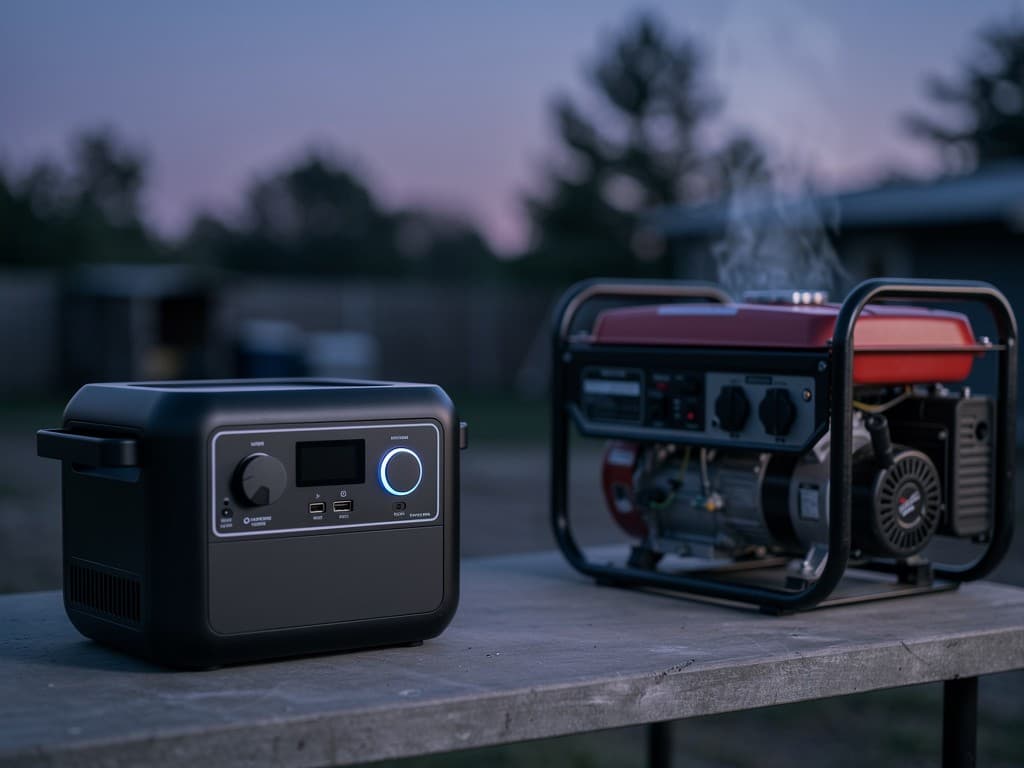
When people shop for emergency power, the comparison usually comes down to two options: portable power stations or gas generators.
Both work — but they solve different problems, and one is often chosen out of habit rather than logic.
This breakdown focuses on real-world use, not marketing claims.
Head-to-Head Comparison
| Factor | Portable Power Stations | Gas Generators |
|---|---|---|
| Noise | Silent | Loud |
| Indoor Use | Safe | Unsafe |
| Fuel | None | Gas / propane |
| Maintenance | Minimal | Regular |
| Startup Reliability | Instant | Variable |
| Long-Term Cost | Lower | Higher |
When Gas Generators Still Make Sense
Gas generators aren't obsolete — they're just specialized.
They still make sense if:
- You need to power an entire home continuously
- You already store fuel safely
- Noise and maintenance aren't concerns
For many households, these conditions don't apply.
When Portable Power Stations Make More Sense
Portable power stations now handle 80–90% of typical emergency needs.
They excel at:
- Refrigeration
- Lighting
- Communication
- Medical devices
- Short-duration tool use
They also work indoors, which is a major advantage.
Hybrid Approaches (Best of Both Worlds)
Some users combine:
- A small generator for rare heavy loads
- Portable power stations for daily emergency use
This reduces fuel use while keeping flexibility.
Which Should You Choose?
If your goal is simplicity, safety, and reliability, portable power stations are the better choice for most people.
If you're comparing specific models:
- Best Portable Power Stations for Off-Grid & Emergency Use
- DIY Emergency Power Setup for Homes & Cabins
Related Reading
- Best Portable Power Stations for Off-Grid & Emergency Use
- DIY Emergency Power Setup for Homes & Cabins
Choose the system that fits your reality — not the one you've always seen.
Modern portable power has changed what emergency readiness looks like.